
Budget of Rs. 2.124 Trillion Announced for Upcoming Fiscal Year; Civil Servants’ Salaries Increased by 21 % ; Budget Attempts to Address All Sectors: Experts
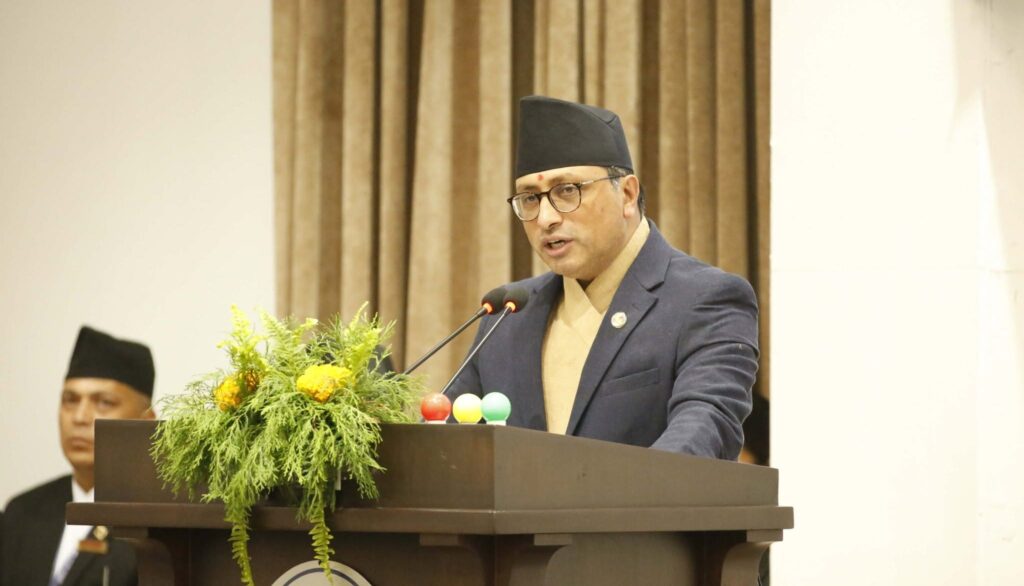
Kathmandu, May 29: The government has allocated a budget of Rs. 2.124 trillion for the upcoming fiscal year 2083/84 BS.
Presenting the budget statement at a joint session of the Federal Parliament, Finance Minister Dr. Swarnim Wagle informed that out of the total allocation, Rs. 1.270 trillion (59.8 percent) has been allocated for recurrent expenditure, Rs. 431.10 billion (20.3 percent) for capital expenditure, and Rs. 422 billion (19.9 percent) for financial management.
The government had allocated a budget of Rs. 1.964 trillion for the current fiscal year 2082/83 BS. Compared to the current fiscal year, the size of the budget for the upcoming fiscal year has increased.
Budget Allocation Breakdown
Recurrent Expenditure: Rs. 1.270 trillion (59.8%)
Capital Expenditure: Rs. 431.10 billion (20.3%)
Financial Management: Rs. 422 billion (19.9%)
Total Budget: Rs. 2.124 trillion (100%)
Green Tax Introduced to Increase Revenue
Through the budget, the government has abolished excise duties imposed on 360 goods and integrated scattered taxes such as infrastructure development tax and road maintenance fees collected at customs points into a unified “Green Tax.”
According to the Economic Bill, the green tax on petrol has been increased from Re. 1 per litre to Rs. 15 per litre. Taxes such as road maintenance fees and infrastructure development tax have been adjusted and incorporated into the green tax. Similarly, the green tax on high-speed diesel has been increased from Re. 1 to Rs. 13 per litre.
Significant Allocation for Energy and Irrigation
The budget presented by Finance Minister Dr. Swarnim Wagle has prioritized energy production, transmission, and distribution lines for the upcoming year. The government has allocated Rs. 85.54 billion specifically for the construction of energy production, transmission, and distribution infrastructure.
Overall, Rs. 114.02 billion has been allocated for the energy, water resources, and irrigation sectors.
The government expects major transformation in irrigation systems to strengthen the country’s energy infrastructure and increase agricultural production.
Ten Percent Tax Increase on Cigarettes
While presenting the budget, Finance Minister Dr. Wagle announced a 10 percent increase in excise duty on cigarettes.
Following the increase, the tax rate on tobacco products in Nepal has now reached 51 percent, up from the previous 41 percent.
The World Health Organization currently recommends a tax rate of up to 75 percent on tobacco products.
Questions Raised on Budget Discipline
The budget presented by Finance Minister Dr. Wagle has promoted digital transformation and good governance while also allocating billions of rupees under administrative expenses and consultancy services.
Observers have noted significant gaps between actual spending from the previous year, revised estimates for the current fiscal year, and targets for the upcoming year. Some inconsistencies have also been observed in the presented figures.
Project-Wise Budget Allocation
According to the budget statement presented at the joint session of the Federal Parliament, Rs. 1.270 trillion, equivalent to 59.8 percent of the total budget, has been allocated for recurrent expenditure.
Similarly, Rs. 431.10 billion has been allocated for capital expenditure and Rs. 422.64 billion for financial management.
Civil Servants’ Salaries Increased by Up to 21 Percent
In the budget for fiscal year 2083/84 BS presented on Friday, the government decided to increase the salaries of civil servants for the first time in four years.
Finance Minister Dr. Wagle announced a 10 percent increase in the “starting scale” salary of government employees. In addition, a performance-based remuneration system will be introduced with an additional 10 percent monthly incentive allowance based on the new salary scale.
“The Budget Has Attempted to Address All Sectors”
Stakeholders have commented that the budget presented by the government has attempted to address concerns of the public, private, and social sectors alike.
Former minister and former ambassador Dr. Bhekh Bahadur Thapa stated that the budget seeks to address government, private, and social sectors.
“Implementation remains to be seen, but the beginning is positive. It has addressed not only the government sector but also the private and social sectors. Challenges are broad, but the start is encouraging,” he said.
Similarly, former Finance Minister Dr. Yubaraj Khatiwada stated that it remains to be seen whether the new arrangements introduced in the budget and the projected economic growth will benefit all sections of society.
“The question is how much the tax exemptions, social security provisions, and private sector incentives will help grassroots people improve their living standards. The main issue is whether all these measures can be effectively implemented,” Dr. Khatiwada said.
He also questioned whether the focus on uplifting the middle class and promoting private sector-led development would truly ensure benefits across all sectors.
Former Finance Minister Janardan Sharma said the budget had attempted to address the government’s political commitments.
“According to the government’s political commitments, efforts have been made to fulfill its promises. Likewise, many policy reforms have been introduced, with emphasis on reforming several laws,” Sharma said.
According to him, the budget is focused on developing the middle class and subsequently increasing employment opportunities.
“If the two-thirds majority is properly utilized, positive results will be seen in economic development and good governance,” he said.
He added that agriculture, tourism, energy, and industrial sectors have been given special priority. The budget also emphasizes innovation, digital economy, agriculture, and the use of artificial intelligence.
“The budget also reflects a commitment to encouraging the capital market, diaspora investment, and the private sector,” Sharma noted.
However, he pointed out that mobilizing the necessary investment to achieve the targeted seven percent economic growth remains a major challenge.