
Nepali AI engineer Arpan Bom joins US Army humanoid robotics challenge as finalist contributor
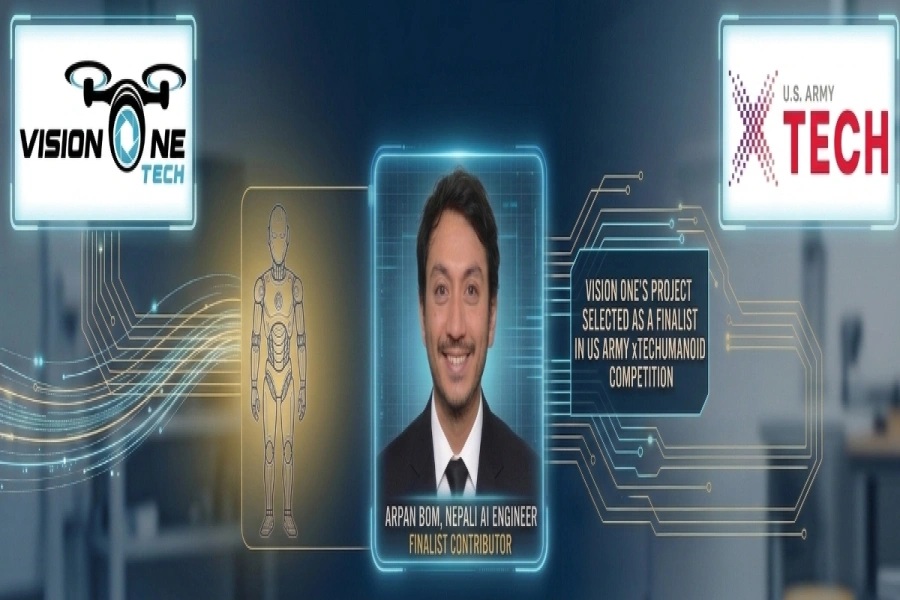
Kathmandu / Aug 21: A Nepali engineer is helping bring artificial intelligence to the next generation of military robotics. Arpan Bom, an AI and software engineer at technology company Vision One, contributed to a humanoid robotics proposal that has been selected as a finalist in the US Army’s xTechHumanoid competition.
The US Army launched the xTechHumanoid competition to identify innovative humanoid systems capable of supporting future military operations. The global competition brings together companies developing advanced robotics, artificial intelligence, sensing, autonomy and humanoid technologies that can operate alongside human personnel in complex and high-risk environments.
Following a competitive evaluation, Vision One was selected as a finalist in the Baseline Humanoid System category. Finalists are invited to a live experimentation event with US Army and Department of Defense subject-matter experts, where they will demonstrate their technologies and contribute to efforts to shape the future of military humanoid capabilities.
Bom, who specializes in artificial intelligence, robotics software, autonomous systems, computer vision and intelligent decision-making, was among the engineers behind Vision One’s finalist proposal. His work focuses on developing software that enables humanoid robots to perceive their surroundings, understand mission objectives and safely interact with people and dynamic environments.
For the xTechHumanoid program, Bom contributed to the intelligent software and autonomy capabilities supporting Vision One’s humanoid platform. His engineering work spans artificial intelligence algorithms, software architecture, perception systems, mission planning, human-robot interaction and autonomous decision support aimed at improving robotic performance in demanding operational conditions.
The Vision One humanoid concept is intended to assist personnel with demanding tasks such as hazardous-environment operations, disaster response, reconnaissance, logistics support and inspection—missions where reducing human exposure to risk is essential. By combining advanced sensing, onboard intelligence and autonomous software, the platform is designed to operate effectively while supporting human teams in complex situations.
“Humanoid robotics represents one of the most exciting frontiers in artificial intelligence,” said Bom, an AI and software engineer at Vision One. “Our goal is to develop intelligent software that allows robots to better understand their environment, make informed decisions and safely work alongside people during challenging missions.”
Being selected as a finalist reflects Bom’s growing experience in AI and robotics software engineering while highlighting the contribution of Nepali engineers to cutting-edge international technology development.